
How Long to Rest a Brisket (And Why Most People Cut It Way Too Soon)
Twenty minutes on a cutting board isn't a rest — it's a head start on disappointment. The Major issues the standing order on resting brisket: the science, the real timeline, and how to hold one for four hours without drying it out.
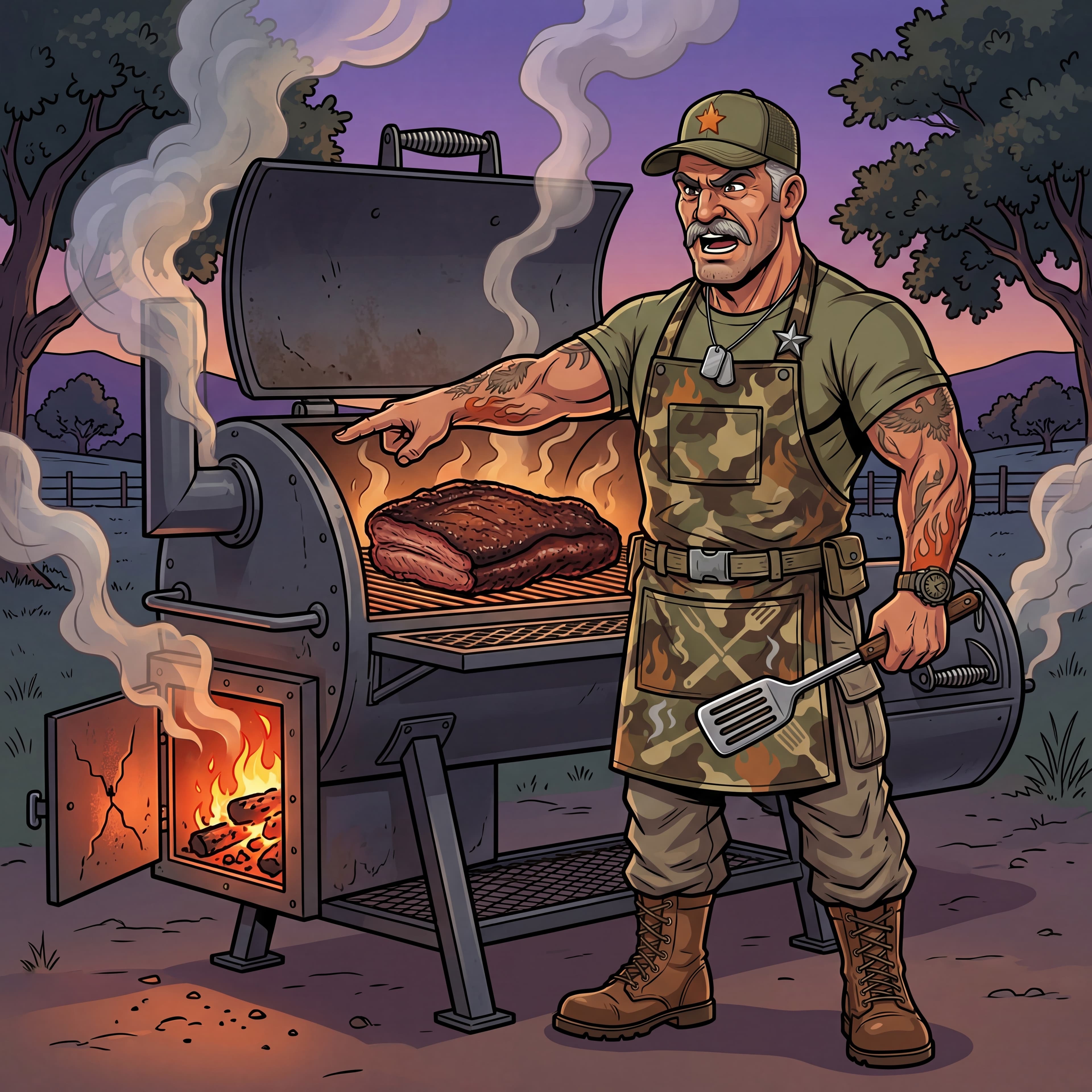
Twenty minutes. That's how long most folks rest a brisket before they saw into it like it owes them money.
Twenty minutes is not a rest, soldier. It's a head start on disappointment.
The Major has watched more good brisket ruined in the last ten minutes than in the fourteen hours that came before it. You trimmed it right. You held your temps. You waited out the stall without panicking and wrapping it in a blanket of fear. And then — because a cousin was hungry and a football game was starting — you cut it hot and watched fourteen hours of juice run onto the board.
Don't fumble the handoff. Today's order: rest it. Properly. Here's the science, the real timeline, and how to hold one for four hours without turning it into a very expensive chew toy.
What Resting Actually Does
Two things happen when you pull a brisket, and both take time.
First: carryover. Heat doesn't stop at the chime of a timer. The outer meat is hotter than the center, and that heat keeps marching inward after the brisket leaves the pit. A big packer will climb another 3 to 8 degrees on the counter. Pull at 203°F expecting 203°F on the plate and you've overshot — the center kept cooking while you weren't looking.
Second, and this is the one everybody skips: the fibers have to stand down. Heat makes muscle fibers contract and wring their moisture toward the center, like a fist squeezing a wet rag. Cut into that fist and the rag empties onto your cutting board. Give it time and the fibers relax, the pressure eases, and the juice redistributes back through the meat where it belongs.
Rushing the rest doesn't save you time. It just moves your brisket's moisture from the slice to the trash.
The Twenty-Minute Myth
Here's where the internet went wrong: it copied steak advice onto a brisket.
A ribeye rests ten minutes because a ribeye is an inch thick and weighs less than your phone charger. A fourteen-pound packer brisket is a different animal — different mass, different thermal problem, different rules. Resting a brisket like a steak is like giving a cargo ship a scooter's stopping distance.
The rule isn't "rest twenty minutes." The rule is "rest until the fibers have actually relaxed." On a full brisket, that is measured in hours, not minutes.
How Long, Actually
The Major's standing order, in order of good-better-best:
- Minimum — 1 hour. Loosely tented, on the counter. This is the floor. Below this you are cutting a fist.
- Better — 2 hours. The juice has redistributed, the slices hold together, the bark hasn't gone to mush.
- Best — a long warm hold, 2 to 4 hours (competition crews go longer). This isn't just resting anymore. It's finishing. Collagen keeps softening, the bark sets, and the texture improves the whole time it sits.
Yes, four hours. The pitmasters serving the briskets people drive three towns for are not pulling and slicing. They're pulling and holding. The rest is not the intermission. On a great brisket, the rest is the third act.
The Cooler Hold (Faux Cambro)
You don't need a five-hundred-dollar warming cabinet. You need a cooler and a towel.
Wrap the brisket — butcher paper if you wrapped during the cook, foil if you want to hold longer and don't mind softer bark. Wrap a towel around that. Drop it into a cooler you've pre-warmed with a jug of hot water (dump the water first), lid down. A decent cooler will hold a brisket above 140°F for four hours without trying.
No cooler? Your home oven set to its lowest mark — usually 170°F — with the wrapped brisket inside does the same job. Crack the door if it runs hot.
One number to respect: keep it above about 140°F the whole hold. Above that line you're finishing a brisket. Below it for hours, you're just storing a cold one — and inviting problems you don't want at a cookout. Hold it hot, slice it warm.
How to Know It's Ready to Slice
Stop guessing by the clock and read the meat.
Slide your probe in. When the internal temp has eased down to roughly 140 to 150°F, it's ready. Still reading 180-plus? The juices are still mobile and will run the second your knife goes in — give it more time. Cooled below 140 and firmed up? You waited too long or held it too cold; it'll slice, but you've left tenderness on the table.
The other tell is the jiggle. Lift the point end. A properly cooked, properly rested brisket wobbles like it's relaxed, because it is. That's the whole point of the exercise.
The Mistakes That Cost You
- Cutting it hot. The single most common way to ruin a good cook. If you can't touch the meat bare-handed, you're too early.
- Resting it sealed tight, straight off the pit, expecting crisp bark. A hard rest in foil softens bark. If crackly bark is the goal, vent it or paper it. Pick your trade.
- Holding it cold. A "rest" that drifts below 140°F for hours isn't a rest — it's leftovers, and a food-safety liability. Warm hold or don't hold.
- Slicing the whole thing at once. Brisket dries out fast once it's open and sliced. Cut what you're serving, leave the rest whole and wrapped.
The Order
Rest it one hour, minimum. Two is better. If you've got a cooler and the discipline, hold it warm at 140-plus for three or four and watch what a real rest does to a slice.
Patience is a weapon. The pit taught the Major that. So did every brisket he ever rushed — each one a little lesson, served dry.
Pull it. Wrap it. Cooler. Lid down. Walk away. Come back when it reads 145, and then slice against the grain.
Low and slow doesn't stop at the pit, soldier. It ends on the cutting board. Carry on.