
Why Your Brisket Stalls at 160°F (And What the Major Does About It)
The stall isn't a bug. It's physics. The Major explains evaporative cooling, the three respectable ways to handle the stall, and which one he actually recommends for 90% of cooks.
Affiliate disclosure: This page may contain affiliate links. As an Amazon Associate I earn from qualifying purchases. Full disclosure.
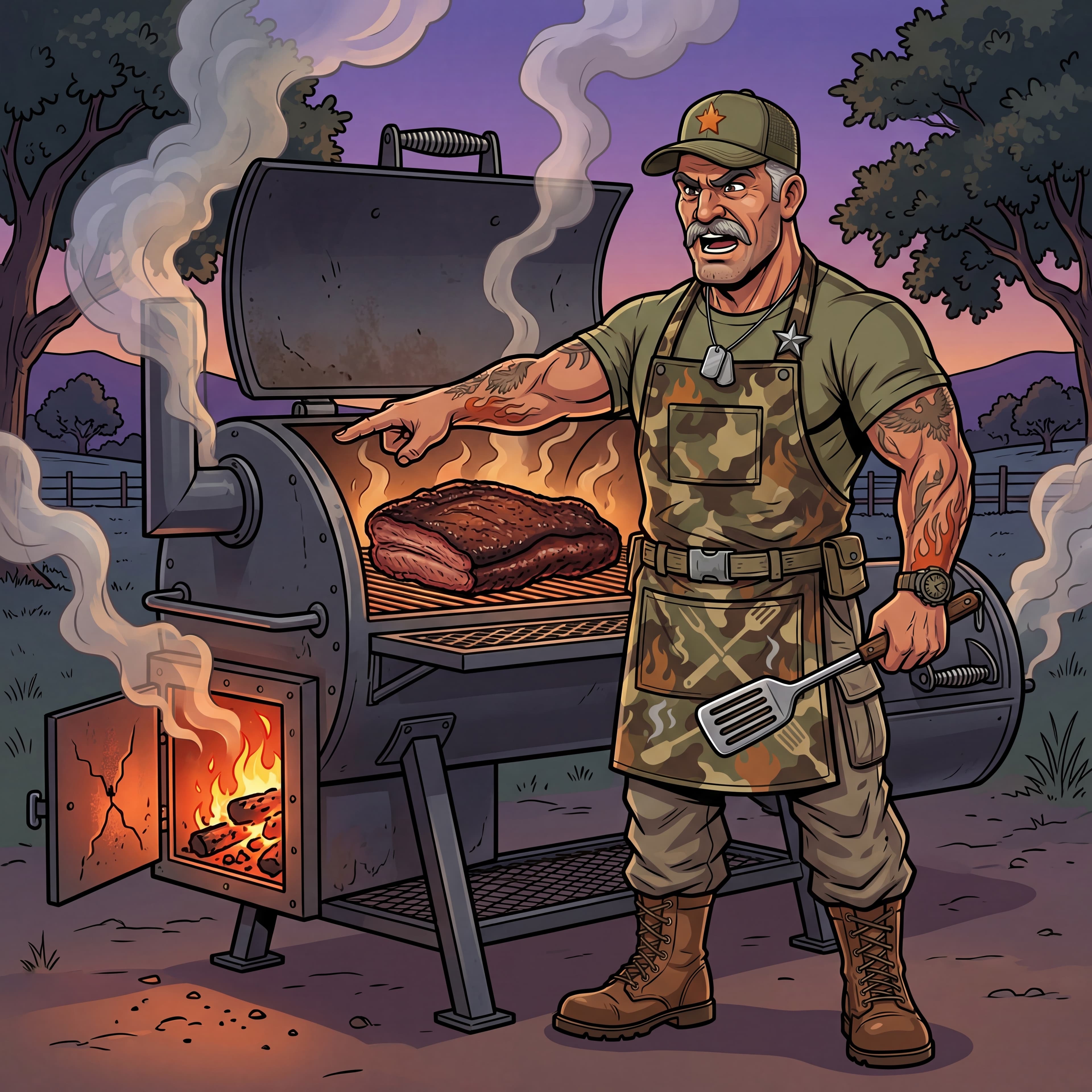
It's 2pm. Your fifteen-pound packer has been on the pit for six hours. You trimmed the hard fat. You rubbed it down with coarse black pepper and kosher salt. The post oak is burning clean, blue smoke is rolling, everything is by the book — and your thermometer has said 162°F for three of those hours. You're in the yard staring at the probe, searching "is my smoker broken" on your phone while dinner guests start asking questions. You're sweating. The meat isn't.
At ease, soldier. The Major's got it from here. Your smoker is fine. Your probe is fine. You've hit the brisket stall, and the stall is physics with a mean little mustache. Put the phone down. We're going to decode what's happening and get this brisket across the finish line.
The Stall Isn't a Bug — It's Physics
The stall isn't a malfunction, a curse, or a magical wall of melting collagen. It's evaporative cooling. The same thing that cools your skin when you step out of a hot shower or a breeze hits a wet forehead in August.
Moisture trapped inside the muscle fibers migrates to the surface of the brisket. Pit heat turns that moisture into vapor. Phase change eats energy — about 540 calories per gram of water evaporated — and that energy comes straight out of the surface of your meat. The pit pushes heat in. The brisket pushes heat out through its own sweat. Those two forces argue for hours and leave your thermometer stuck in the middle.
If that sounds like a theory, it isn't. Dr. Greg Blonder, a physicist at Boston University, proved it with an experiment any one of us could run. He put a block of pure beef fat and a water-soaked sponge in the same smoker. The fat climbed steadily to the set temperature. No stall. The sponge, with zero collagen, zero protein, zero anything people used to blame, stalled exactly the way a brisket stalls. Water in. Water out. Temperature flat as a parade ground. That settled the argument for good.
The brisket stall temperature lands between 150°F and 170°F, and the plateau holds for two to six hours depending on pit humidity, airflow, and how heavy-handed you got with the spritz bottle. An offset stick-burner with strong draft will stall harder and longer than a tightly sealed kamado, because moving air strips evaporated moisture off the surface and runs the cooling effect at full efficiency. Sometimes the needle drops a degree or two on the way through. Don't court-martial the thermometer. Physics is doing what physics does.
Why It Ends (So You Know It Will)
The stall ends because the meat runs out of easy surface moisture to sweat out.
Hours into the cook, the exterior dehydrates. The rub sets. Fat at the surface starts to tack up. That dark mahogany shell forming on top isn't decoration — it's dehydrated meat, rendered fat, smoke, salt, and pepper doing honest work. Pitmasters call it bark. Physics calls it the exit door.
As the surface dries, less moisture evaporates. Less evaporation means less cooling. The balance finally tips, pit heat wins, and your internal temp breaks out of the 160s and resumes its climb. 162°F for four hours. Then 168°F. Then 175°F. The worst part is behind you. Nothing got fixed because nothing was broken.
Three Ways to Beat the Brisket Stall
Three respectable options. Each one works. Each one has a cost. Pick the one that fits your mission: bark, speed, or balance.
Option 1: Ride Out the Brisket Stall (The Purist Move)
Do nothing. Lid down. Fire clean. Trust the cook.
This is competition-level Texas brisket and it's the move when bark is the point. You let the evaporative phase run to the end with nothing wrapped, nothing shielding, nothing rushing it. The surface dehydrates uninterrupted. The Maillard reaction runs to its conclusion. You pull the blackest, crackliest, most probe-tender bark your pit can produce.
The cost is time and nerve. A 14-pound packer that would finish in ten hours wrapped can take thirteen or fourteen ridden out. You'll need to start before the rooster and run it through the night. You'll also need steady nerves, because when the probe reads 162°F for five hours, your brain will start inventing problems. Don't listen to it.
The Major's honest opinion: ride it out when the mission is bark over all. Competitions. Cookouts where you're the main event. Days when "best brisket possible" beats "dinner by six." Otherwise, pick a wrap.
Option 2: The Texas Crutch (The Practical Move)
Wrap the brisket and you shorten the stall dramatically. Texas crutch brisket is how most of the best backyard briskets in America actually get cooked, and there's no shame in the technique. You're not surrendering. You're changing the battlefield.
The mechanism is simple. Wrap the meat and you trap moisture against the surface. The exterior sits in its own humid little pocket. Evaporation can't carry heat out to the open air anymore. The internal temp climbs again in minutes instead of hours.
Which wrap matters. Heavy-duty foil seals completely, which means you're basically steaming the brisket through the finish. You'll punch through the stall in 45 to 90 minutes — the fastest option on the board — but the bark softens because it's sitting in liquid. That's pot-roast territory.
Pink butcher paper, unwaxed and food-grade, breathes. Moisture still escapes, slower. You'll shave one to two hours off the stall, keep your bark mostly intact, and end up with something that still eats like real Texas brisket. Aaron Franklin built an empire on this technique. Foil is a rain poncho. Paper is a field jacket. Choose based on the weather.
When to wrap: 160°F to 165°F internal, and the bark has to be set. Scrape a fingernail across it. If the rub smears off on your finger, you wrapped too early. If the crust holds, you're cleared to proceed. Wrap tight — no air pockets — and keep cooking until probe tender, usually 200°F to 205°F.
Wrap it in foil and you're making pot roast. Wrap it in paper and you're making brisket.
Option 3: The Spritz (The Middle Path)
Spritz every 45 to 60 minutes with apple cider vinegar and water, 50/50, or thin beer if the cooler has one to spare. Keep the surface pliable. Help smoke cling to a tacky exterior. Don't drown it.
Understand what the spritz does and doesn't do. It doesn't end the stall. Adding moisture to a surface that's trying to dry actually extends the evaporative phase, which means you're feeding the stall, not breaking it. What you're really buying is bark quality: protection for the thin edges of the flat while the point renders, and a deeper final flavor from smoke binding to a slightly wet exterior.
The Major's verdict: legitimate technique, when used like one. Spritz like a pitmaster, not a firefighter. A few light passes. Lid down. Walk away.
What NOT to Do
Three wrong moves. You see all of them on r/smoking every weekend.
Don't crank the pit to "break through" the stall. Pit temperature doesn't cause the stall and it doesn't end the stall — surface evaporation does. Ram the cooker to 325°F and you'll render the fat wrong, split the bark, and pull a mealy, dry-edged brisket off the grates. Hold your temp. Hold your line.
Don't open the lid every ten minutes to check. Every peek vents heat and restarts the climb. Every peek is a fifteen-minute fine. If you can't see the meat, you can't mess with it. That's a feature.
Don't pull the brisket early because the flat temp is scaring you. The stall always ends. Pulling at 165°F hands you a tough, undercooked brisket nobody asks for a second slice of. Physics is patient. You be patient too.
The Major's Call
For the 90% case — backyard, weeknight, Sunday football, dinner party — butcher paper at 165°F is the answer. Wrap once the bark is set. Cook to probe tender, somewhere around 203°F, where the probe slides in like warm peanut butter across the whole flat. Rest at least an hour. Two or three is better. A long hold in a dry cooler will only make it more tender. Slice across the grain. Serve.
Ride it out when you've got the daylight and you want your best work on the plate. Use foil when the clock has you by the apron and dinner has to land on time. Spritz along the way if it keeps your hands busy.
One standing order through all of it: stay on the probe. The stall can end 5°F early or three hours late, and no chart outranks the meat in front of you. A fast, accurate instant-read like the Thermapen ONE is your situational awareness. Your hands confirm the report.
Further Orders
- Run your numbers through the Pitmaster Calculator before the cook so you know how much brisket you're actually feeding.
- Grab the free printable meat temperature field guide and tape it where panic can see it.
- Follow the full cook in the Major's Texas brisket guide.
- Check the Major's gear intel before you buy another thermometer, spritz bottle, or four-figure smoker.
- The Major drops deeper technique briefings in the Officer's Club every month. Enlist when you're ready for the next rank.
Low and slow. That's the whole order.